Ten years ago, I started banking online. At the time, it was a radical idea, the security of the Internet--that is, performing personal financial transactions, or even buying online--was in doubt at the time, but I'd grown tired of calling the automated number and punching in additional digits just to navigate. That and my bank started to charge for automated calls beyond the provided three free calls. Online banking allows you to check balances, view activity, order checks, transfer funds, even pay bills 24-7. Now banks would like to go one step further by offering services via mobile. Once again, there are security concerns, but the banks feel they have a handle on it this time around.
Early adopters
Research presented at this week's Cardtech SecureTech (CTST) conference in San Francisco shows that people are uneasy about handling their financial services needs on a mobile phone. According to Javelin Strategy & Research, a financial services survey company, across all age groups, 33 percent of those surveyed thought mobile banking was too risky, while 34 percent were unsure if it was a good idea. The bright spot, they found was, in the 18-to-24 age range, where respondents were decidedly more interested in using mobile banking and less concerned about security.
The latter is not too surprising. The 18-to-24 group doesn't remember the online viruses and notorious Internet hacking of the early 1990s, when online banking was trying to gain a foothold. Unlike the online world, mobile systems have yet to be marked with viruses and malware. That's about to change. In 2006, there were about 60 viruses using mobile operating systems; in 2007, experts are predicting that number will rise to more than 400 viruses. Add to that snoopware--spyware written especially for mobile devices with cameras--and the relative dangers of online transactions vs. mobile transactions become roughly similar. Yet banks are proceeding cautiously with their offerings, propelled, in part, by the 18-to-24-year-olds who currently live and die by their mobile phone usage, and the belief that carriers and phone users will start using security software to protect the various assets currently stored on mobile devices.
 |
According to Javelin Strategy & Research, a financial services survey company, across all age groups, 33 percent of those surveyed thought mobile banking was too risky, while 34 percent were unsure if it was a good idea.
|
 |
Banks
Wachovia has a mobile banking program in place with AT&T (formerly Cingular). CitiBank is carrier independent, which means customers must download an application; unlike Wachovia, but CitBank's service is available on AT&T, Verizon, and Sprint. Bank of America is in limited testing. Well Fargo says they're studying the service. Oddly, Well Fargo was one of the first banks to try mobile banking in 2002 but later withdrew it after limited trials.
But mobile banking is already a hit elsewhere. South Aftrica, Kenya, Zambia, and the Democratic Republic of the Congo are all offering mobile customers banking services. Cell phone use in Africa has exploded from just 1 million users in 1996 to over 100 million today. The Philippines, Japan, Korea, and Singapore also offer mobile banking services.
Security
One of the main obstacles in the United States is security. In general, cell phone signals are harder to hack into, thus cell-modems are a much safer way for a laptop to connect to the Internet than public Wi-Fi. However, many new mobile phones are now integrating Wi-Fi services, so traditional hacking methods may soon come into play with mobile banking. To counter this, Wachovia is using encrypted user names and passwords; Citibank also encrypts its user name and password. Visa USA goes further, allowing customers to disable an account from a lost cell phone by going online. MasterCard is using a one-time password for each session.
Still, you are seeing only limited banking services at this time. Most allow you to only view recent activity and check balances. That way, if your phone is ever stolen, the thieves would be able to see only how much you have in your account--not have access. A few banks are allowing customers to transfer funds, with an eye toward allowing stock trades later on.
You are seeing only limited banking services at this time. Most allow you to only view recent activity and check balances. That way, if your phone is ever stolen, the thieves would be able to see only how much you have in your account--not have access.
|
 |
 |
Natural limitations
But the experience of banking on a mobile device is not similar to online banking. One, the display is much smaller, limiting what the bank can show, so viewing multiple accounts or providing too many options just doesn't work. Two, typing on a mobile device is different than typing at a keyboard. You may not want to be doing data entry to bring your accounts up to date.
The banks say they are working on customer interfaces, but that's hard to pull off. The phone carriers each have their own distinct look and feel and do not welcome outside advice. The banks, meanwhile, have to use secure practices learned from the online world. For example, CitiBank's service is a download, so that the bank can control the look and the security of the service, but, as a download, it faces the risk of become a lost icon, buried by carrier services on the mobile screen. The other institutions are using the carrier's browsers, but are then limited to one or two carriers.
The future
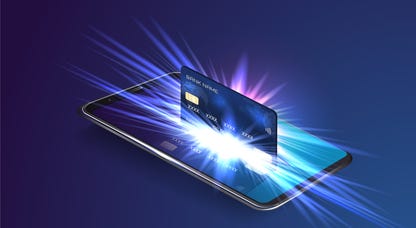
If mobile banking does catch on, it's likely to open the door for mobile purchases or electronic wallets. Future cell phones will use near-field communication (NFC) chips to communicate with special readers in stores, allowing you to purchase items through your cell, eliminating the need to carry a credit card. If that happens, Visa and MasterCard, both of which are testing this technology, will need to overcome the biggest problem facing mobile users: loss or theft of the mobile device. And, if your mobile device does become an electronic wallet containing personal information more valuable than just custom ringtones, you can bet mobile phones will become an even bigger target for thieves, both real-world and virtual.
If offered, would you do your banking by mobile phone now? Or wait a year or so? TalkBack to me.