Version: 2008
  • On TechRepublic: Why Android beats iPhone
advertisement
mySimon mySimon mySimon Outdoor Gear mySimon Swimwear mySimon Home and Garden
Fully Equipped: The electronics you lust for.

Should you wait for an OLED TV?

By David Carnoy 
Executive editor, CNET Reviews
(June 11, 2007)

There's a guy over on AVS Forum, Gus738, that we like to mock. OK, maybe not mock, but we always thought his signature tagline--Waiting for SED--was amusing in its geeky videophile pretentiousness.

For those who don't know what SED is, it stands for "surface-conduction electron-emitter display," and until a few weeks ago, it was the next big thing in flat-panel TVs. SED enthusiasts are quick to note that it offers all the impressive picture-quality traits of a traditional tube TV, but it's as slim as a plasma. Unfortunately, some next big things don't quite pan out, and it now looks like Mr. Waiting for SED, as we like to call Gus738, is going to be waiting a while longer--perhaps forever. Alas, Toshiba and Canon became snared in a legal imbroglio over patent disputes with a company called Nano-Proprietary, which put a damper on the commercial development of SED TVs. Toshiba declared that its partner wasn't able to produce SED panels "to the original schedule," while Canon stated the obvious when it observed that, "The prices of flat-panels are declining more rapidly than expected," making it virtually impossible for SED to compete against plasma and LCD.

It was a cruel day for HD aficionados. After a couple of years of teasing us with SED prototypes, we were promised that retail units were tantalizing close--they'd be in stores by year's end, Canon said. LCD and plasma would have a new competitor. And while SED sets would assuredly have been very pricey (rumor had it that a 42-inch model would be in the $5,000-to-$8,000 range), those willing to spare no expense for the finest picture quality in a flat-panel display would have had something to throw their money at. Let's not forget that small but vocal group of cynical observers who like to chide today's flat-panel buyers for overpaying for "yesterday's" technology. (These are the same people who like to say holographic discs are on the way, so why bother with Blu-ray or HD DVD).

Sadly, SED wasn't meant to be. So, what do we have to look forward to? What acronym will carry the mantle for flat-panel of the future?

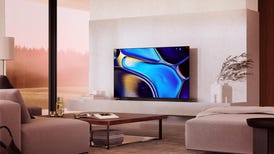
The one that everybody likes to talk about is OLED or Organic Light-Emitting Diode. At this year's Consumer Electronics Show in Vegas, Sony had a pack of them on display at its booth, and they were clearly one of most compelling items at a trade show that was decidedly short on wow factor. Not only is an OLED display incredibly thin (3mm to 9mm), it has a superhigh contrast ratio (allegedly, one-million-to-one), it boasts faster response times than LCD or plasma, it looks incredibly sharp with colors that really pop--and because OLED screens don't require a backlight, they're more energy efficient than plasma or LCD.

OLED screen
OLED screen depths are measured in millimeters.

The big problem is that it's currently very hard to make OLED TVs in large sizes; for instance, the largest OLED display Sony had on hand at CES was 27 inches. Also, manufacturers are still experimenting with the display's organic materials to increase the lifespan to the point where OLED panels' lifespan would be competitive to that of plasma's. Lastly, OLED also has its own set of patent issues surrounding it--Kodak holds a number of patents--which means manufacturers such as Sony and Samsung will be required to pay a licensing fee for every OLED TV they produce.

After the SED debacle, it's easy to get cynical about the prospects of OLED unseating plasma or LCD as the flat-panel champ any time soon. However, I think that ultimately, while SED had plenty of fanboys like Gus738, its basic problem--and why it was never going to make it--was that it didn't have a real advantage over LCD or plasma. By that I mean its picture quality wasn't that much better. The fact of the matter is that, when you looked at an SED prototype next to a plasma or LCD, you didn't immediately declare it the winner--you actually had to look and think about it. As I said, it looked really good, but at the same time, plasmas and LCD panels have been improving, and in the end, the difference just wasn't that significant. And ultimately, I think, that's the reason Canon and Toshiba abandoned SED.

OLED, on the other hand, holds one key advantage: the panels are much thinner than LCD or plasma. And in a world where flat-panel TVs are looking increasingly alike, with subtle picture-quality difference, companies will be focusing more and more on the design of their TVs.

What do you think the chances are of OLED unseating LCD and plasma as the flat-panel champ?
To a certain degree, Sharp executives said exactly that at a recent press luncheon I attended in New York. With 1080p gradually becoming more of a standard feature on HDTVs (flat-panel and rear-projection sets), it becomes harder and harder to set TVs apart from a features standpoint (you might call it features saturation). For instance, Sharp--and other manufacturers--are touting 120Hz refresh rates in their new LCDs. The faster refresh rate is supposed to help eliminate motion blur, one of the knocks against LCD. But once LCD manufacturers get beyond the motion-blur issue and continue to improve black levels, the feature improvements will become very incremental, and there will be an increased focus on design.

Sharp execs said they were keeping an eye on OLED. They're not terribly worried yet, particularly because of OLED's current size constraints. But if Sony is able to put out an OLED model this year as it's now promising (it's only an 11-inch display, but to get anything out on the market would be an achievement--even if it's ridiculously expensive), their concern might rise a touch.

The long and short of it is, if you're waiting for something better than LCD or plasma to come along, chances are you're going to have to wait a long time. OLED appears to have a lot of promise, but I don't expect to see an affordable 42-inch model for another five to six years. It's possible that smaller OLED displays (20 inches or less) will become options for kitchens, bedrooms, and bathrooms in somewhere closer to three years, but like SED, the technology might never pan out--or make sense economically.

That said, true diehards like Gus738 seem intent on holding out and sticking with their current sets. As he said in a recent post, "Well, all in all, I hope OLED makes it [?] cuz I want a better TV then the current pos LCD/PDPs?so far my CRT tube is making it?." I would humbly suggest, however, that he change his tagline from Waiting to SED to Waiting for OLED. Just a thought.

What do you think OLED's chances are of unseating LCD and plasma as the flat-panel champ? To get your two cents in, click the TalkBack button now.

More commentary
Buzz Report
Molly Wood
Taking a bite out of hype.
Security Watch
Robert Vamosi
Don't get burned by viruses and hackers.
Fully Equipped
David Carnoy
The electronics you lust for.
On Call
Kent German
Solutions for your wireless woes.
Driving It
Wayne Cunningham
What's hot and what's not in car tech.