Panasonic HD-PLC Ethernet Adapter

CNET Editors' Rating

3.0 stars
    Overall score: 6.8 (3.0 stars)

Good

All prices Set price alert
Panasonic HD-PLC Ethernet Adapter - overview Panasonic HD-PLC Ethernet Adapter - front Panasonic HD-PLC Ethernet Adapter - side Panasonic HD-PLC Ethernet Adapter - back
Play Video
Scroll Left Scroll Right
  • Panasonic HD-PLC Ethernet Adapter - Video
  • Panasonic HD-PLC Ethernet Adapter - overview
  • Panasonic HD-PLC Ethernet Adapter - front
  • Panasonic HD-PLC Ethernet Adapter - side
  • Panasonic HD-PLC Ethernet Adapter - back

CNET Editors' Review

CNET Editors' Rating

3.0 stars Good
    Overall score: 6.8 (3.0 stars)
  • Setup and ease of use: 8.0
  • Features and security: 6.0
  • Performance: 7.0
  • Service and support: 5.0
  • Reviewed by: Felisa Yang
  • Released on:
  • Reviewed on:
Edited by: Matthew Elliott

The good: The Panasonic Ethernet adapters are easier to set up and configure than a wireless home network, and you won't have to pull Ethernet cables through the house. The throughput rate is more than fast enough for sharing a broadband Internet connection, and it should be sufficient for transmitting high-definition video content.

The bad: Even though you don't have to run cables through your house, you'll still have an unsightly mess of cables around each adapter, especially if you're using a hub/switch to connect multiple devices to a single adapter.

The bottom line: If you're not on the wireless bandwagon, you don't have to forgo a home network or pay to have a network professionally installed. With the Panasonic HD-PLC power-line Ethernet adapters, you can have a wired home network up and running in minutes.

Review: Despite the prevalence of wireless home networks, some people just aren't ready to cut the cord. Maybe you've already tried a Wi-Fi home network and found it too much of a hassle to set up and maintain, or perhaps Robert Vamosi's Security Watch column has you running for the hills and swearing allegiance to the Luddite way of life. If either describes you, then power-line Ethernet adapters are worth looking into. Panasonic's power-line offering--the HD-PLC Ethernet adapter--is dead simple to install and use. On the downside, the adapters aren't cheap; if you have a lot ... Expand full review
Despite the prevalence of wireless home networks, some people just aren't ready to cut the cord. Maybe you've already tried a Wi-Fi home network and found it too much of a hassle to set up and maintain, or perhaps Robert Vamosi's Security Watch column has you running for the hills and swearing allegiance to the Luddite way of life. If either describes you, then power-line Ethernet adapters are worth looking into. Panasonic's power-line offering--the HD-PLC Ethernet adapter--is dead simple to install and use. On the downside, the adapters aren't cheap; if you have a lot of devices you want networked around your house, the needed adapters could run you hundreds of dollars. And despite the fact that you don't have to pull cables throughout your house, you'll still have to deal with an unsightly tangle of wires around each adapter.

Power-line technology uses a building's existing electrical system as a conduit for electronic data. The wall outlets serve as connection points, or nodes, on the network. Transferring data over the electrical network doesn't interfere with your electricity because data is transmitted at a higher frequency than electricity. Power-line systems involve connecting your router into the master adapter via a standard Ethernet cable and plugging that adapter into a wall outlet. Network clients are plugged in to additional adapters, which are also plugged in to wall outlets; basically, anywhere you have a wall outlet, you should be able to connect to your network via an adapter. Some power-line adapters, such as Netgear's WGXB102, mix Ethernet connections with wireless capability by rolling a wireless access point in to the wall-plugged unit, letting you extend the reach of your wireless network anywhere you have an electrical outlet. Panasonic's adapters don't incorporate wireless technology but still allow you to easily extend your network.

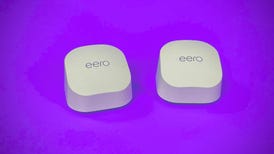
Panasonic's Ethernet adapters are about the size and shape of a bulky point-and-shoot camera. The only components are a power port, an Ethernet jack, a master/terminal switch, and a setup button. Unlike the petite Netgear XE102 Powerline Adapter, the Panasonic HD-PLC uses a power cable to connect to the wall outlet. It won't block an additional outlet, but this does mean you'll be faced with yet another cord.

Setting up Panasonic's HD-PLC Ethernet adapters couldn't be easier. The best way is to begin with the starter kit, which comes with two preconfigured adapters, because you'll need at least two to create a network. Simply plug in the Master adapter (so labeled) to a wall outlet near your router. Then plug in the second Terminal adapter anywhere you want to have access to your network. At this point, the three LEDs should light in different combinations to indicate whether the adapters are set up correctly (the included installation guide outlines the meanings of the lights). If all is set up correctly, the final step is simply to connect your equipment, such as PCs, networkable printers, and NAS hard drives, to the adapters via Ethernet cable. Unfortunately, the adapters don't come with Ethernet cables, a shortcoming we can't forgive, as Netgear's XE102 adapters come with a six-foot cable and even wireless routers come with an Ethernet cable for connecting the router to a modem.

Your router should be connected to the Master adapter. Each adapter has only one Ethernet port, but you can connect it to a hub or a switch (from any networking vendor) to network multiple devices using a single adapter (Panasonic recommends a maximum of eight devices per adapter and a max of 16 adapters per network). If you need more than the two adapters that come in the starter kit, which costs about $200, you can purchase Panasonic HD-PLC adapters individually for about $130. Because these aren't preconfigured to the Master adapter, you'll have to configure them by plugging them into the same wall outlet as the Master, pressing the setup buttons on both units, and waiting for the indicator lights to show that the new adapter has been successfully set up. At that point, you can move the new adapter to any other point in the house. We were set up and on the Internet in mere minutes. If you have an adapter in each room of the house, the cost can add up quickly to hundreds of dollars. With a wireless network, you can often add clients to the network using a $50 wireless USB adapter. Of course, as mentioned above, you can use one adapter to network up to eight clients, so that helps keep the cost down. Unfortunately, it does nothing for cable clutter.

Hide Review

Compare to other bridges

Compare selected

select

Panasonic HD-PLC Ethernet Adapter Starter Pack

Panasonic HD-PLC Ethernet Adapter Starter Pack Starting at $149.95

  • Editor's rating: 3.0 out of 5

select

Western Digital WD Livewire Powerline AV Network Kit

Western Digital WD Livewire Powerline AV Network Kit Starting at $79.00

  • Editor's rating: 4.0 out of 5

select

D-Link DHP-501AV PowerLine AV 500 Adapter Starter Kit

D-Link DHP-501AV PowerLine AV 500 Adapter Starter Kit Starting at $107.95

  • Editor's rating: 4.0 out of 5

select

Netgear Powerline HD Ethernet Adapter

Netgear Powerline HD Ethernet Adapter Starting at $179.98

  • Editor's rating: 3.5 out of 5

User Reviews

Be the first to rate this product

Write a Review

Quickly sign in with: or Log in or create an account to post a review.
Add Your Opinion

The posting of advertisements, profanity, or personal attacks is prohibited. Click here to review our site terms of use.

Specifications

See full specs

Quick Specs

  • Networking type: Bridge
  • Dimensions (W x D x H): 4.8 in x 1.6 in x 2.8 in
  • Connectivity technology: Wired

Sponsored Premier Brands on CNET

Which Wireless Network is right for me?

Laptop Finder

With so many possible ways to build a network, it pays to home in on the solution that best suits your needs before you buy.

We've compiled a handful of typical user profiles that should help outline what type of wireless network is right for you.

Read our guide