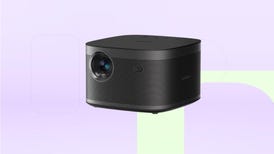
Nikon D40 (with 18-55mm lens)

CNET Editors' Rating

3.5 stars
    Overall score: 7.5 (3.5 stars)

Very good

Average User Rating

84 reviews

All prices Set price alert
Nikon D40 (with 18-55mm lens) - top Nikon D40 (with 18-55mm lens) - side Nikon D40 (with 18-55mm lens) - back
Scroll Left Scroll Right
  • Nikon D40 (with 18-55mm lens) - top
  • Nikon D40 (with 18-55mm lens) - side
  • Nikon D40 (with 18-55mm lens) - back

CNET Editors' Review

CNET Editors' Rating

3.5 stars Very good
    Overall score: 7.5 (3.5 stars)
  • Design: 8.0
  • Features: 7.0
  • Performance: 7.0
  • Image quality: 8.0
  • Reviewed by:
  • Released on:
  • Reviewed on:

The good: Excellent feel and compact size; very customizable menu architecture; nice guidance for dSLR newbies; excellent noise characteristics for high-ISO shots.

The bad: Slow kit lens; occasionally slow to focus; only 6 megapixels; raw editing software costs extra; control scheme can be awkward; no automatic sensor cleaning.

The bottom line: The Nikon D40 is a great transition camera for going from point-and-shoot to your first dSLR.

Review:

In many ways, you might consider Nikon's D40 the Zelig of digital cameras. Is it a digital SLR with the spirit of a point-and-shoot? Is it a point-and-shoot with the power of a dSLR? It depends upon who's doing the shooting. While the D40 will never morph into an ultracompact or grow up to be high-powered, pro shooter's camera, it covers the in-between fairly well.

Positioned at the very bottom of Nikon's dSLR food chain, the company aims the D40 at first-time dSLR buyers moving up from tricycles to training wheels. As ... Expand full review

In many ways, you might consider Nikon's D40 the Zelig of digital cameras. Is it a digital SLR with the spirit of a point-and-shoot? Is it a point-and-shoot with the power of a dSLR? It depends upon who's doing the shooting. While the D40 will never morph into an ultracompact or grow up to be high-powered, pro shooter's camera, it covers the in-between fairly well.

Positioned at the very bottom of Nikon's dSLR food chain, the company aims the D40 at first-time dSLR buyers moving up from tricycles to training wheels. As such, it contains an assortment of preexisting parts from its siblings: the same (or very similar) 6-megapixel sensor as its predecessor, the D50, the same processing engine as the D200 and the same 420-pixel sensor 3D Color Matrix Metering II metering system found in the D80. Assuming that the dSLR-craving hordes of newbies don't have any lenses yet, Nikon sells only a kit version, bundling in its new f/3.5-to-f/5.6G, 18mm-to-55mm II ED AF-S DX lens (28.8mm to 88mm equivalent). This assumption also informs Nikon's decision to remove the coupling pin from the lens mount, limiting the capabilities when interfacing the camera with lenses other than the newer AF-S and AF-I models. In other words, this isn't your father's Nikon, and it isn't the camera to buy if you've got a stash of Dad's old Nikon lenses. (You can find the compatibility details here).

Following recent trends in entry-level dSLRs, Nikon dropped the second status LCD on top of the camera in favor of a more hands-on role for the 2.5-inch LCD on the back. A single button press brings up a display of all your current settings; a second press allows you to navigate and change those settings using the four-way-plus-OK navigation switch and command dial. If you're used to shooting with a snapshot camera, it will feel very familiar; if you're accustomed to more streamlined combinations of buttons and dials, it can feel a bit clunky. For instance, in aperture-priority mode, you can change the aperture only via the command dial; to change the shutter speed, you must go through the aforementioned process. Nikon does provide an Fn button to which you can assign button-plus-dial access to image size/quality, ISO sensitivity, white balance, or drive mode, but I just hate it when manufacturers force me to choose an arbitrarily most-important setting from among several important ones.

Nikon D40
As part of its friendly face, the Nikon D40 offers several options for how it displays your current shooting information, although you always use the same screen while changing settings (upper left). The ring in the Graphic display is supposed to somehow clue novices in to the relationship between shutter speed and aperture, but it just doesn't work for me. And I find the Wallpaper option annoying.

Nikon D40
One of the useful features that Nikon copied from its--and others'--snapshot cameras is using thumbnails to depict for which types of photos different options are appropriate. The camera also supplies some of the in-camera editing features common to point-and-shoots, such as red-eye reduction, D-Lighting (auto exposure adjustment), cropping, and filter effects.

Nikon did bring the viewfinder up to date, one of the things we complained about on the D50, by upping the magnification from 0.75X to the more common 0.8X. Interestingly, it still lacks a grid overlay, a feature I'd think many beginners would appreciate--plus some of us veterans who still have problems getting that horizon line right. And Nikon actually dropped the number of focus selection points from 5 to 3. When I shoot, I use only the center point--after a brief flirtation with eye-controlled autofocus in film cameras, I returned to that old focus-and-recompose school--so it didn't bother me. However, if you use the various automatic focus-selection-point modes it could make a big difference in your shots.

Hide Review

Compare to other digital cameras

Compare selected

select

Canon EOS Rebel T3

Canon EOS Rebel T3 Starting at $449.99

  • Editor's rating: 3.5 out of 5

select

Nikon D3100

Nikon D3100 Starting at $596.95

  • Editor's rating: 3.5 out of 5

select

Canon EOS Rebel T3i

Canon EOS Rebel T3i Starting at $699.95

  • Editor's rating: 3.5 out of 5

select

Nikon D5000

Nikon D5000 Starting at $1,302.37

  • Editor's rating: 3.5 out of 5

Average User Rating

4.0 stars out of 84 user reviews

Rating Breakdown

  • 5 star: 66
  • 4 star: 12
  • 3 star: 3
  • 2 star: 1
  • 1 star: 2

My Rating

0 stars click stars to rate product

CNET Community

This product is on 78 user lists. Add to my list

Most Helpful User Review

4.5 stars 120 of 120 users found this review helpful

"Only 6 megapixels?" By rieramr

Pros Great image quality, nice size, fast and friendly to use. Perfect entry level dslr.

Cons Get better glass...kit lens is cheap.

Summary I recently purchased my D40 as a backup and I must say the image quality is tremendous. You will be able to do beautiful A4, A3 enlargements. I recently got back a poster sized print of the George Washington Bridge- Awesome! I don't understand why CNET's Lori Grunin ... Expand full review

Most Recent User Reviews (Showing 2 of 84 reviews)

By mufn8r

Where to Buy

See all prices Set price alert

Specifications

See full specs

Quick Specs

  • Digital camera type: SLR
  • Product Type: Digital camera - SLR
  • Resolution: 6.1 megapixels

Sponsored Premier Brands on CNET

Where to Buy

See all prices Set price alert

Which digital camera is right for me?

Laptop Finder

In order to choose the right camera--one with the right set of features at the right price--you'll need to figure out what you'll be doing with it.

In this guide, we've compiled a handful of typical user profiles to help outline the specific uses for digital cameras. Match your needs to one of these user profiles to determine the digital camera that's right for you.

Read our guide | Step-by-step digital camera finder