CNET editors' review
-
CNET editors' rating:
stars
Excellent
Detailed editors' rating
- Reviewed on: 04/10/2009
- Updated on: 09/25/2009
- Released on: 04/01/2009
Editors' note: The features rating on this review has been reduced from 9 to 8 based on changes in the competitive marketplace.
As HDTVs become more common--some would say commoditized--TV makers go to greater lengths to justify higher price tags. Nobody is going as far as Samsung this year. The company is the only one thus far to announce a full lineup of edge-lit LED-based LCDs, which cost a mint yet offer the most advanced technology and design you can get--at least until OLED comes along.
Each model among the three series of Samsung's edge-lit LED-based LCD lineup measures just 1.2 inches thick, thanks to that LED lighting system, which is also responsible for the TVs' excellent energy efficiency. The UNB7000 series is the middle child in terms of price and features of the three; yet, it includes buckets of add-ons, many of them interactive, along with extensive picture adjustments including a cool new tweakable dejudder mode. In our performance testing, we encountered some picture quality trade-offs caused by the LED system, namely less-than-perfect uniformity and off-angle viewing, along with the backlights' somewhat distracting fluctuations. These issues keep the UNB7000 series from earning our highest accolades for performance, but in terms of design and features, the expensive televisions set a standard that will be tough to beat.
Series note: We performed a hands-on evaluation of the 46-inch UN46B7000 ($2,999 list price), but this review also applies to the 40-inch UN40B7000 ($2,399) and the 55-inch UN55B7000 ($3,799). All three sizes share identical features and specifications. Samsung also has a retailer-specific series currently exclusive to Best Buy, the UNB7100 models, that are identical but for gray coloring, as opposed to red, and with overall cosmetics similar to the step-up UNB8000 series.
Design

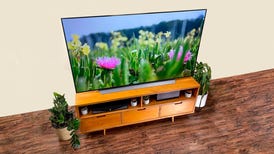
Did we mention these TVs are really thin? The UNB7000 measures just 1.2 inches deep at its thickest point, and tapers even thinner toward the edges of the panel. Samsung offers a special flush wall mount, and if you decide to keep the TV on its stand, the thin panel will look equally impressive from the side. From the front the set is no slouch either; a slim, subtle red border edges all four sides of the panel, while the outer transparent edge lends a jewel-like look. On the downside, you can't get it in any color but red, aside from the gray 7100 series.

The matching stand is also edged in red, and a unique transparent pedestal keeps the thin panel gracefully suspended above its surface. We appreciate that the stand lets the TV swivel to either side.
Aside from the obvious thinness, the LEDs allow for a couple other design bonuses. The UNB7000 runs a lot cooler than other LCD and plasma displays producing a similar amount of light, and the panel itself weighs less than other models.

Samsung used the same menu system as last year, albeit with red borders to match the TV itself, and we still think it's one of the best in the business. Big, highly legible text is set against transparent backgrounds that occupy almost the whole screen. Getting around is easy, there's helpful explanatory text along the bottom, and we dug the context-sensitive menu that would pop up occasionally to provide more options. One cool extra reserved is a built-in "product guide" that takes you through the TV's myriad features.

The remote control is basically the same as last year, aside from a new protrusion on the rear that keeps the clicker stable on a flat surface, and we're definitely fans--especially since Samsung ditched the rotating scroll wheel. The buttons are big, backlit, and easily differentiated by size and shape, and we liked the dedicated "Tools" key that offers quick access to the E-manual (see below), picture and sound modes, the sleep timer, and the picture-in-picture controls. We didn't like the remote's glossy black finish, however, which picked up more than its share of dulling fingerprints after a few minutes. The company also includes a small, nearly useless hockey-puck-style remote that only controls channel, volume, and power.
Features
Edge-lit LED backlighting heads the UNB7000's feature set. Samsung calls these sets "LED TVs," but it's important to remember they're actually otherwise normal liquid-crystal display TVs that use light-emitting diodes instead of the standard fluorescent backlights--check out the slideshow for more information.
We've reviewed LED-based LCD screens before, most recently the Sony KDL-55XBR8 and Samsung LN46A950, which both use local dimming technology; groups of LEDs behind the screen can be dimmed or turned off to achieve those deep, inky blacks we all love so much. None of Samsung's edge-lit LED-based LCDs use local dimming, which might be one reason they didn't perform as well as those local dimming displays (see Performance section for details).

New for 2009, Samsung has added Yahoo widgets to its higher-end sets including the UNB7000 series. The system gathers Internet-powered information modules, called "snippets," into a bar along the bottom of the screen, and each can be activated to reveal the full-fledged widget. The model we reviewed came with widgets for stocks, weather, news, and access to Flickr photos, and we expect more widgets to be available shortly. Check out our full review of Yahoo widgets for more information.

Other interactive features on this set abound. It can stream videos, photos, and music from DLNA-certified devices via the network connection, as well from its USB ports, which can connect to MP3 players, USB thumbdrives, and digital cameras (we haven't tested this capability yet, but will update this review when we do). There's also built-in "content" such as recipes, games, workout guides, and a slideshow of high-definition art and photos with music. We went into depth discussing the content features last year, which are similar this time around, so for more details check out the Interactive section of the 2008 Samsung LN46A750 review.

Samsung's panoply of picture-affecting features starts with a 120Hz refresh rate and dejudder processing, the latter with more adjustments than we've seen on any such display so far. We also liked the myriad conventional picture adjustments, starting with four adjustable picture modes that are all independent per input. There are five color temperature presets that are augmented by the capability to adjust each via a custom white balance menu; three varieties of noise reduction, including an automatic setting; a film mode to engage 2:3 pull-down (it also works with 1080i sources); a seven-position gamma control that affects the TV's progression from dark to light; a dynamic contrast control that adjusts the picture on the fly; a "black tone" control that affects shadow detail; and a color space control that lets you tweak the Samsung's color gamut.

You can choose from four aspect ratio modes for HD sources, two of which let you move the whole image across the screen horizontally and vertically. As we'd expect from a 1080p TV, one of those modes, called Screen Fit, lets the UNB7000 scale 1080i and 1080p sources directly to the panel's pixels with no overscan--the best option unless you see interference along the edge of the screen, as can be the case with some channels or programs.

We appreciate the three power-saver modes, which further reduce energy use. As far as other conveniences, Samsung throws in picture-in-picture, an "E-manual" on a USB thumbdrive, and even a customer care screen that includes the firmware version for when you need to call the company. We're also big fans of the new-for-2009 capability, unique among HDTVs, to download firmware directly to the TV, rather than making you go to the Web site, as was the case before.

The UNB7000 series offers good connectivity, as long as your AV system doesn't have many analog components. The highlight is four HDMI inputs, arranged vertically along the shallow connection bay on the back of the TV (note that fat cables might not fit the nearly flush sockets very well). You also get two USB inputs, a VGA-style PC input, and a single component-video input that can be converted to accept composite video instead. An RF input for antenna or cable, an optical digital audio jack, and the Ethernet port complete the picture. If you need to connect more than one analog device, you'll need to use a switcher or an AV receiver.
Continue readingMost helpful user reviews
- Average user rating: 3.5 stars out of 27 reviews
- My rating: 0 stars Write review
-
Showing 3 of 27 user reviews
-
8 out of 10 people found this helpful
-
7 out of 10 people found this helpful
-
3 out of 4 people found this helpful
- See all 27 user reviews Write review


Samsung UN46B7000: